
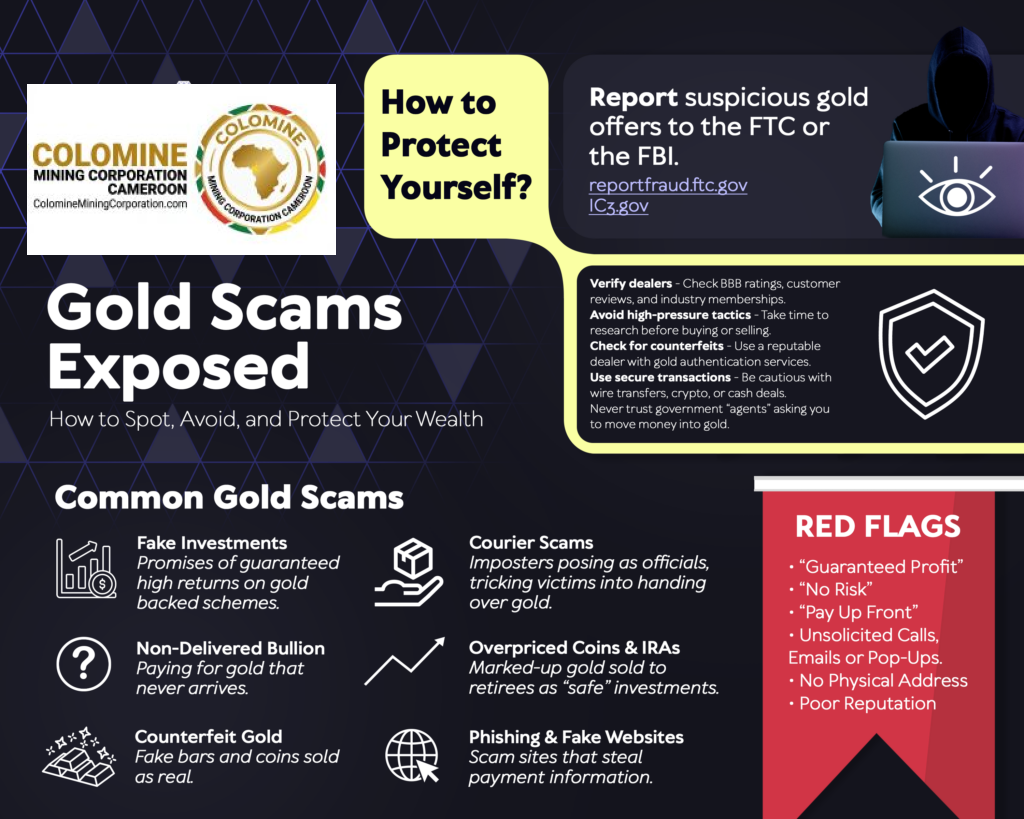
How to Spot an Advance-Fee Gold Scam: A Buyer’s Protection Guide for Central and West Africa
How to Spot an Advance-Fee Gold Scam: A Buyer’s Protection Guide for Central and West Africa from Colomine Mining Corporation (COMINCOR SA) Cameroon.
Every advance-fee gold scam has the same heartbeat: you pay something small now for something big later, and the big thing never arrives. The “small” thing can be a permit fee, an export tax, a security deposit, a “recovery” charge or a deposit to unlock a withdrawal. The “big” thing can be a kilogram of gold, a profitable trade or your own money back.
Knowing how to spot an advance-fee gold scam matters most for buyers dealing across Central and West Africa, where much gold changes hands informally, paperwork is hard to verify from abroad and fraudsters know it. This guide explains how advance-fee scams work, gives you the warning signs, shows how the same trick appears in fake gold sales and fake trading platforms, covers how to tell real gold from fake, and sets out a verification routine you can use before you pay anyone.
It is written for gold traders, precious-metals buyers, jewelry buyers and manufacturers, institutional investors and industrial users. It is general education, not legal or financial advice, and it does not accuse any individual of wrongdoing.
Quick Answer: 10 Warning Signs of an Advance-Fee Gold Scam
- A price below the spot price, or a “special” discount for you.
- Any request for money before the gold is tested, secured and delivered: permit, tax, courier, security, “sample” or “release” fees.
- A “refundable” or “deductible” fee that keeps being followed by new ones.
- Certificates, permits and letters that only the seller can show you.
- An escrow, shipping or customs service recommended by the seller.
- Pressure, deadlines and “another buyer is waiting”.
- Payment requests by gift card, crypto, cash or transfer to a personal or third-country account.
- Contact only through messaging apps, with no verifiable company or office.
- Guaranteed returns or “AI trading” profits on a platform you cannot verify.
- Trouble withdrawing money, followed by a demand for “taxes” or more deposits.
Key Takeaways on How to Spot an Advance-Fee Gold Scam
- Advance-fee fraud exists in every country. The pattern, not the nationality of the seller, is the warning.
- Legitimate sellers, escrow providers and officials do not require fees to be paid to personal accounts or in gift cards.
- Verify with the issuing authority or laboratory using contact details you found yourself.
- Scam websites and apps change names and domains. A new name does not mean a new company.
- Home tests can screen out crude fake gold. Only laboratory assay settles the question.
- If you are already a victim, beware of recovery scams that demand another fee.
Advance-Fee Scams Explained: How Do They Work?
An advance-fee scam asks you to pay money up front in return for a promised benefit that never materialises. Law-enforcement agencies call it a classic fraud type. It is often called “419” fraud after the section of the Nigerian criminal code that covers it, but it is run from and against people in every part of the world, and treating it as a feature of one country is both wrong and unhelpful. What matters is how it works.
The five-stage pattern
| Stage | What the scammer does | What it feels like to you |
|---|---|---|
| 1. The hook | Offers gold below market price, or a profitable trade, with a friendly tone | A lucky find |
| 2. The proof | Sends photos, videos, scanned permits, certificates and letters | Everything checks out |
| 3. The first fee | Asks for a small “refundable” payment for a permit, sample or tax | A reasonable cost of doing business |
| 4. The escalation | Invents problems that need more money: customs, security, bank holds, withdrawal “taxes” | I have already paid, so I must finish |
| 5. The exit or the second hit | Vanishes, or returns as a “recovery agent” to charge another fee | Loss, shame and sometimes a second loss |
Expert insight: Advance-fee scams work through commitment, not stupidity. Each small payment makes the next feel logical. The most effective defence is a rule you set before you start: no money moves until the seller, the permits and the metal have all been independently verified.
Advance-Fee Scam Examples in the Gold Trade
The same mechanic appears in several forms. These examples are patterns reported by fraud-prevention agencies and gold buyers, not accusations against any named person.
| Example | The advance fee | How it ends |
|---|---|---|
| Cheap gold from “a mining cooperative” | Permit, assay, export tax or “security company” fees | No gold, or fake or plated metal |
| Gold “stuck in customs” | Release fee, bribe or storage charge | No shipment exists |
| Fake gold buyer | Buyer asks you to pay “insurance”, “tax” or “shipping” before paying you | No payment arrives |
| Fake escrow or vault | Deposit into a look-alike escrow service | Funds disappear with the website |
| Fake trading or investment platform | Deposits to “unlock” profits or withdrawals | Withdrawals blocked, more fees demanded |
| Recovery scam | Fee to retrieve money from an earlier scam | A second loss |
How to Spot a Gold Scam Online
Most gold scams now start online. People search for “how to spot a gold scam online”, “how do you spot gold trading scams” and “how do you spot gold investing scams” because the signals are different from face-to-face deals. Use this checklist.
- Check how old the website is. Look up the domain registration date at ICANN Lookup. A “long-established mine” or “trusted exchange” whose domain is a few weeks old is a major warning.
- Use website-checking tools as clues, not verdicts. Services such as ScamAdviser score sites using signals like domain age, reviews and hosting. A low score is a reason to stop. A high score is not proof of honesty, because new scam sites can look clean and legitimate sites can score badly.
- Search the exact name with “scam”, “fraud” and “warning”. Also search regulators’ alert pages. The International Organization of Securities Commissions (IOSCO) hosts an investor alerts portal that collects warnings from member regulators around the world.
- Check whether the firm is registered to do what it claims. Offering investments, trading or derivatives usually requires registration with a securities or financial regulator in the country where you live.
- Reverse-search photos. Pictures of gold bars, offices and “staff” are often copied from other sites.
- Look for a physical address and verify it. Check the registered company number and directors with the official company registry.
- Test how the contact behaves. Real businesses answer questions about registration, licensing and process. Scammers deflect, change the subject or move you to a private chat.
- Never rely on a “gold scammer list” or “top scammer list” alone. See the section below.
Case File: What Regulators Said About BG Wealth Sharing, DSJ Exchange and HQI Exchange
Many people searching for scam warnings land on queries such as “what happened to BG Wealth”, “BG Wealth Sharing Ltd website”, “BG Wealth login”, “DSJ scam”, “HQI exchange platform” and “BG crypto coin”. These are not gold schemes, but the public warnings about them show an advance-fee pattern that gold buyers also meet, so they are a useful, documented case study. The facts below come from public statements by securities regulators. They are paraphrased and reflect what those regulators have said so far.
Case File
- The Alberta Securities Commission described BG Wealth Sharing as an online cryptocurrency and multi-level marketing scam tied to a trading platform called DSJ Exchange (also written DSJ EX). It placed the scheme on its caution list in January 2026, issued an investor alert in February 2026 and, on 25 May 2026, issued cease-and-desist letters to promoters. It also said that the BG Wealth Sharing website was seized by US law enforcement in late April 2026.
- The ASC said the scheme claimed to use AI-generated trading signals to deliver guaranteed returns, spread through recruiters, referral networks, social media and messaging apps, and that victims had difficulty withdrawing funds.
- Regulators in other places, including Quebec’s AMF, Ontario’s OSC, Saskatchewan’s FCAA, Alaska’s securities division and Washington State’s financial institutions department, issued their own warnings that the entities were not registered or authorised to solicit investors, and the AMF’s list also names HQI Exchange.
- Regulators and investor-education bodies reported that, as the scheme struggled, people were asked for further deposits or fees before they could withdraw, and warned that victims could be targeted again by “recovery” offers and rebrands.
For the regulator’s own account, read the Alberta Securities Commission news release and the CheckFirst investor-education summary.
If you are searching for a login: Do not log in, deposit or pay any “tax”, “fee” or “upgrade” to any platform linked to these names, including mirrors, reboots or similarly named sites. Contact your securities regulator and your bank instead. If a name resembles one of these, such as “BG Graceful Wealth” or another “BG” brand, do not assume it is related or unrelated. Verify it independently.
How to Spot a Fake Trading Platform and Gold Investing Scams
Gold is a favourite lure for fake platforms because it sounds safe. How to Spot an Advance-Fee Gold Scam, Gold options trading scams, fake exchanges and “gold-backed” tokens often use the same script.
| Warning sign | Why it matters |
|---|---|
| Guaranteed or very high returns, “AI signals” | Real markets carry risk, and no one can guarantee profit. |
| Recruitment bonuses for bringing friends | A hallmark of pyramid and Ponzi structures. |
| No verifiable registration with a financial regulator | Legitimate trading platforms are usually licensed where they sell. |
| Only an app or website, no real company contact | Hard to hold anyone accountable. |
| Withdrawal problems, then “tax”, “fee” or “verification” payments | The advance-fee trap inside an investment scam. |
| Domains and app names that change | Scam sites move when they are flagged. |
| Pressure to use crypto or gift cards | Hard to trace and reverse. |
| Fake “gold options” or leveraged gold with no real broker | Your deposit may never reach any market. |
Before depositing, check the firm on your regulator’s registration search, read the regulator’s warning lists, confirm the company’s identity and ask how withdrawals work in writing. If you cannot withdraw a small test amount quickly and without fees, do not add more.
A note on “trade scam Roblox” searches
Searches such as “trade scam Roblox” come from gaming, not gold, but the pattern is the same: a stranger offers a great deal, asks you to go first or hand over something valuable, then disappears or invents a new fee. Children and teenagers are common targets. Teach young people the same rule: never send anything first, and never use outside links or chats to complete a trade.
How to Spot Fake Gold: Materials, Names and Tests
Fake gold material and what fake gold is called
People search “fake gold material” and “fake gold is called” because sellers use many terms. Common ones include gold-plated, gold-filled, gold-tone, vermeil (gold over sterling silver), rolled gold, and base-metal alloys such as brass or copper. How to Spot an Advance-Fee Gold Scam, “Fool’s gold” is the mineral pyrite. In bars, the best-known fraud is a tungsten core with a gold layer, because tungsten’s density is almost the same as gold’s (about 19.25 against 19.32 grams per cubic centimetre).
How to spot fake gold at home
| Home check | What it can show | Limits |
|---|---|---|
| Magnet | Rules out magnetic base metals | Many fakes are not magnetic |
| Weight and size against specification | Flags items that are clearly off | Tungsten can match |
| Hallmark and stamp inspection | Flags blurry or odd marks, or plated-gold abbreviations such as GP, GF and HGE | Stamps can be faked |
| Colour and wear | Base metal showing at edges and clasps | Good plating hides it |
| Ceramic scratch or acid test | Surface reaction | Can damage items and only tests the surface |
| Float test | Crude check on cheap fakes | Unreliable for good counterfeits |
How to spot a fake gold stamp, coin or bar
- Stamps: real 18K or 750 marks are crisp and consistent. Uneven, shallow or oddly placed marks, or terms such as “gold plated”, are warning signs. Even a good stamp is only a claim.
- Coins: compare weight, diameter, thickness and design details with the mint’s published specifications, and buy from mint-authorised dealers.
- Bars: check the refiner’s mark, weight, dimensions and serial number, then ask the refiner to confirm the serial number using contact details you found yourself.
- Certainty: use ultrasonic testing, XRF and fire assay through an accredited laboratory, and control the sample yourself.
For a deeper look at forged assay certificates and tungsten bars, read our guide on gold scam red flags in Cameroon.
How to Spot a Real Gold Mine or Mining Project
Searches for “how to spot a gold mine” often mean “how do I tell a real gold mine or project from a fake one”. How to Spot an Advance-Fee Gold Scam, Scammers love to invent mines because buyers cannot easily visit them. Check:
- The licence: confirm the permit, its holder and area with the national mining authority. In Cameroon, start with the Ministry of Mines (MINMIDT). In Ghana, the Minerals Commission is the usual starting point. Other countries have their own registries.
- The technical report: serious exploration and mining projects publish independent technical reports under recognised standards, such as the JORC Code or Canada’s NI 43-101. If none exists, treat resource claims as marketing.
- The operator: verify the company, its directors, its history and its financial backing.
- The production record: real mines have tax records, shipment documents and refinery receipts, not just photos.
- The inspection route: use an independent inspector. Do not travel to remote areas on a seller’s invitation. The US State Department advisory for Cameroon lists several regions, including parts of the East and Adamawa where gold is mined, at Level 4 (do not travel).
Advance-Fee Risks in Central and West Africa: What Buyers Should Know
Gold is mined across Central and West Africa, from Cameroon to Ghana, Mali, Burkina Faso and beyond. How to Spot an Advance-Fee Gold Scam, Much of it comes from artisanal and small-scale miners, so trade is often informal. That creates real opportunities for buyers and fertile ground for fraud, for three reasons.
- Informal chains are hard to verify. The Extractive Industries Transparency Initiative has documented large gaps between Cameroon’s declared gold exports and imports reported by partner countries, which shows how much gold moves outside formal channels.
- Real fees exist, so fake fees sound plausible. Permits, taxes, assay and logistics are real costs, which makes invented ones easy to believe. The answer is never to pay them to the seller. Real costs are paid to authorities, laboratories and carriers you have verified, or are built into a protected contract.
- Distance helps scammers. Buyers abroad cannot easily check documents, so forged letters on ministry letterhead and look-alike escrow sites work.
Our companion guides explain the legitimate side of the trade: sourcing gold from Cameroon, gold exporters in Cameroon and how to verify a gold supplier in Cameroon.
“Gold Scammer List” and “Top Scammer List”: Why They Are Not Enough
Buyers often search for a “gold scammer list” or “top scammer list”. Treat these with care. Unofficial lists are frequently unverified, outdated or written by competitors, scammers change names and phone numbers constantly, and innocent people can be named by mistake. A name missing from a list proves nothing. A name on it is a reason to investigate, not a verdict.
Better sources are official warning lists maintained by securities regulators and consumer agencies, such as those collected on the IOSCO investor alerts portal, plus your own checks of registration, licences, domain age and references. For gold deals, add direct confirmation of permits with the issuing authority and independent assay.
Recovery Scams: The Second Hit
After a loss, victims are often contacted by people offering to recover their money for an upfront fee, a “tax” or a “release” payment. Regulators, including the Alberta Securities Commission, warn that fraudsters target recent victims, sometimes using details from the original scam. No legitimate recovery service demands payment in advance to release funds that supposedly sit waiting for you. Report instead to your bank, the police and fraud authorities, such as ReportFraud.ftc.gov and the FBI Internet Crime Complaint Center in the United States, or your national equivalent.
What Different Buyers Should Do
Gold traders and precious-metals buyers
Apply the same know-your-counterparty process to every deal: company checks, permit confirmation, origin records, independent assay and protected payment. Screen against sanctions lists such as OFAC and follow FATF-aligned anti-money-laundering standards.
Jewelry consumers and manufacturers
Have jewelry and raw gold tested independently, compare quotes against the spot price and keep batch records. Treat hallmarks as claims until tested.
Institutional investors and central banks
Buy refined bars from accredited refiners listed by the LBMA, with confirmed serial numbers, secure custody and an auditable chain of title.
Technology and industrial manufacturers
Require multi-element assay and batch traceability. Fake or contaminated gold can damage production, and undocumented gold can breach your customers’ sourcing policies.
Common Mistakes That Make Advance-Fee Scams Work
- Paying the “small” first fee: it creates commitment and invites bigger demands.
- Using the seller’s escrow, lab or inspector: choose your own.
- Trusting documents without checking the issuer: forgeries are easy.
- Believing a polished website or app: they are cheap to build and quick to replace.
- Keeping the deal secret: talk to your bank, accountant or lawyer.
- Chasing lost money by paying more: the next fee is rarely the last.
- Relying on one tool or list: scam checkers and scammer lists are clues, not proof.
How to Avoid Advance-Fee Scams: A Buyer’s Protection Routine
- Set your rule first. No payment before independent verification of the seller, the permits and the metal.
- Calculate the fair price. Use the live spot price and treat large discounts as a warning.
- Verify the company. Registration, tax status, owners, address and domain age.
- Confirm permits with the authority using contact details you found yourself.
- Confirm certificates with the laboratory and run your own assay on a sample you control.
- Choose a protected payment structure. A letter of credit, licensed escrow you select or pay-on-assay terms. Never fees to the seller, gift cards or third-party accounts.
- Use independent inspection and insured shipping.
- Pause under pressure. Real sellers wait for verification.
- Keep records of every message, document and payment.
- Report suspected fraud early to your bank, police and regulator.
Frequently Asked Questions
How do I spot an advance-fee gold scam? What is an advance-fee scam? How do advance-fee scams work? What are examples of advance-fee scams in gold? How do I avoid advance-fee scams? How do I spot a gold scam online? How do I spot fake gold at home? How can I tell if a gold bar is fake? How can I tell if a gold coin or stamp is fake? What is fake gold called? How can I spot a fake trading platform? What happened to BG Wealth Sharing? Can I trust ScamAdviser or a scammer list? What should I do if I have paid an advance fee?
Conclusion: Verify First, Pay Last
Advance-fee gold scams succeed because they feel like normal business: a fee here, a permit there, a deadline that seems fair. The fix is a single habit. Nothing is paid until the seller, the paperwork and the metal have been verified independently, and no fee is ever paid to the person selling to you. Apply that habit across Central and West Africa, and most of these schemes fail at stage one.
If you want a gold supply relationship built on documentation, independent testing and protected payment, contact Colomine Mining Corporation (COMINCOR SA). Tell us the form, fineness and volume you need, and ask for our due-diligence documentation before you commit.
Sources and further reading: Alberta Securities Commission, 25 May 2026; CheckFirst: What investors can learn from the BG Wealth Sharing scam; IOSCO; US Federal Trade Commission; EITI: Cameroon’s gold gap. Regulator warnings and facts about named schemes may change. Check current information before acting.
Leave a Reply