Gold Deposits in Africa: Where They Are and How Buyers Approach Them
Gold deposits in Africa are among the richest and most geologically varied on Earth. The continent holds the Witwatersrand Basin in South Africa, the Birimian greenstone belts of West Africa, the Tanzanian craton, and thousands of alluvial districts that artisanal miners have worked for generations. For gold traders, jewelry manufacturers, central banks and industrial buyers, understanding where gold occurs, and which jurisdictions have credible legal supply chains, is the first step to sourcing responsibly.
This guide covers the largest gold deposits in Africa, the top countries by reserves and output, deep dives on Ghana, South Africa and Cameroon, and the due-diligence steps serious buyers use. It is written for Colomine Mining Corporation (COMINCOR SA) readers who want facts before any transaction.
Table of Contents
- Quick Answer: Gold Deposits in Africa at a Glance
- Key Takeaways
- Where Do Gold Deposits Form? What Creates Them?
- Main Types of Gold Deposits in Africa
- Top Countries With the Most Gold in Africa
- Largest Gold Deposits and Mines in Africa
- Gold Deposits in Africa Map: Reading the Regions
- Gold Deposits in South Africa
- Gold Deposits in Ghana
- Gold Deposits in Cameroon
- Gold Deposits in Nigeria
- New Gold Deposits Found in Africa
- Who Buys African Gold and Why
- How to Buy African Gold Safely: Step by Step
- Expert Insights
- Common Mistakes
- Best Practices
- Working With Colomine Mining Corporation (COMINCOR SA)
- Frequently Asked Questions
- Conclusion
Quick Answer: Gold Deposits in Africa at a Glance
Africa has gold in more than 30 countries. South Africa holds the single largest historic deposit (the Witwatersrand Basin), while Ghana is generally Africa’s largest current producer. Mali, Sudan, Burkina Faso, Tanzania, Guinea, Côte d’Ivoire, the DRC and Zimbabwe are also major producers. Cameroon has gold mainly in alluvial and artisanal districts in its East and Adamawa regions.
Featured answer: The largest gold deposit in Africa is the Witwatersrand Basin in South Africa, which has yielded roughly 40% of all gold ever mined. The largest current African producer is typically Ghana.
Key Takeaways
- The Witwatersrand Basin is the world’s most productive gold field; its output dwarfs every other deposit.
- West Africa’s Birimian belts (Ghana, Mali, Burkina Faso, Côte d’Ivoire, Guinea) produce most of Africa’s new gold.
- Reserve figures differ by source and year; always cite USGS or company reports with dates.
- Artisanal and small-scale mining supplies a large share of African gold, so provenance checks matter.
- Legal export requires licences, assay reports, and customs and tax documents. Verify all of them with the government before paying.
Where Do Gold Deposits Form? What Creates Gold Deposits?
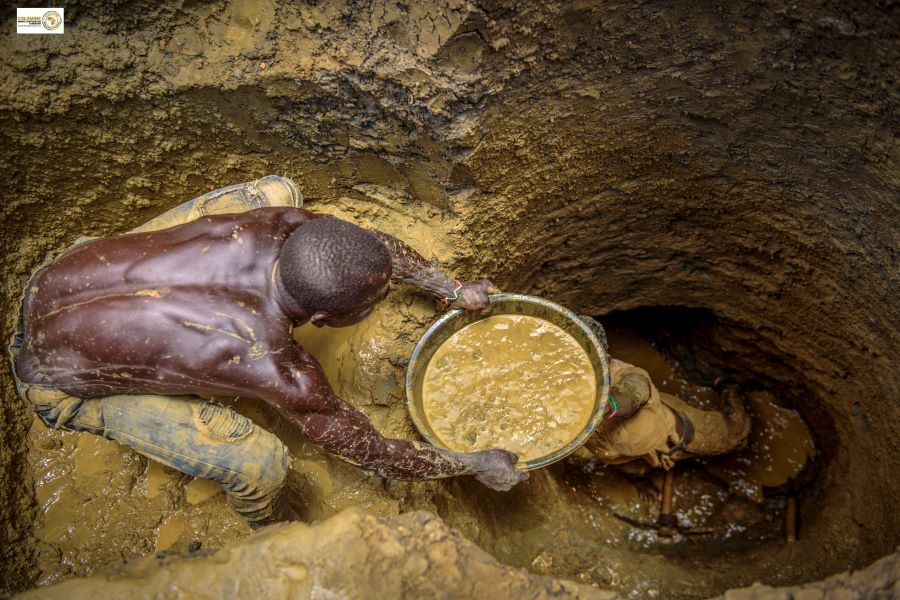
Gold is concentrated by geological processes that move and trap it. The most important mechanism is hydrothermal fluid flow: hot, mineral-rich water circulates through fractures in the crust, dissolves trace gold, and deposits it in quartz veins and shear zones when temperature and pressure drop. Over millions of years, erosion can release that gold and rivers concentrate it into placer (alluvial) deposits.
So where are gold deposits found? Mostly in ancient rock belts called greenstone belts, along major fault systems, in volcanic and intrusive settings, and in river gravels downstream of those sources. Africa is rich because it contains some of Earth’s oldest stable crust (cratons) with extensive greenstone belts.
Main Types of Gold Deposits in Africa
| Deposit type | How it forms | African examples |
|---|---|---|
| Paleoplacer (conglomerate) | Ancient river gold buried and lithified | Witwatersrand (South Africa), Tarkwa (Ghana) |
| Orogenic lode | Hydrothermal veins in shear zones | Obuasi and Ahafo (Ghana), Loulo (Mali), Geita (Tanzania) |
| Alluvial / placer | Modern river gravels and terraces | Eastern Cameroon, Ghana’s Ankobra and Pra basins, Guinea |
| Eluvial / laterite | Gold residually enriched in weathered soil | Parts of West and Central Africa |
| Epithermal / volcanic-hosted | Shallow hydrothermal systems | Sukari (Egypt) |
| VMS and others | Seafloor volcanic sulphide systems | Parts of Sudan, Egypt, Eritrea |
Top Countries With the Most Gold Reserves in Africa
Two measures are often confused: reserves (economically mineable gold underground) and production (gold mined each year). The U.S. Geological Survey publishes annual reserve and production estimates. The table below gives an indicative ranking; check the latest USGS summary for current numbers.
| Rank (indicative) | Country | Why it matters |
|---|---|---|
| 1 | South Africa | Largest historic reserves; Witwatersrand Basin |
| 2 | Ghana | Africa’s top producer in recent years; large and small-scale sectors |
| 3 | Mali | Major industrial mines such as Loulo-Gounkoto and Syama |
| 4 | Sudan | Large artisanal output |
| 5 | Burkina Faso | Gold is its leading export |
| 6 | Tanzania | Geita, North Mara, Bulyanhulu |
| 7 | Guinea | Siguiri and extensive alluvial fields |
| 8 | Côte d’Ivoire | Growing industrial sector |
| 9 | DR Congo | Kibali, plus artisanal Ituri and Kivu |
| 10 | Zimbabwe | Greenstone belts, many small-scale operators |
Top 20 countries with gold in Africa. Beyond the ten above, Egypt, Ethiopia, Namibia, Senegal, Niger, Nigeria, Cameroon, Mauritania, Sierra Leone and Liberia all have notable gold occurrences or active mines. Rankings shift with discoveries, political conditions and mine closures.
How many gold deposits are there in Africa? No single authoritative count exists, because definitions of a “deposit” differ and artisanal sites are often unmapped. Geological surveys and industry databases track thousands of occurrences and several hundred significant deposits.
Largest Gold Deposits and Mines in Africa
- Witwatersrand Basin (South Africa): the largest known gold field in history, including deep mines near Johannesburg.
- Tarkwa and Damang (Ghana): Tarkwaian paleoplacer system.
- Obuasi (Ghana): a historic underground district operating for over a century.
- Ahafo and Akyem (Ghana): large modern open-pit operations.
- Loulo-Gounkoto and Syama (Mali): among West Africa’s biggest mines.
- Kibali (DRC): one of the largest gold mines on the continent.
- Geita, North Mara and Bulyanhulu (Tanzania): Lake Victoria greenstone belt.
- Sukari (Egypt): Eastern Desert’s flagship mine.
Gold Deposits in Africa Map: Reading the Regions
A gold deposits in Africa map typically shows five clusters:
- Southern Africa: Witwatersrand and Barberton (South Africa), Zimbabwe craton.
- West Africa: Birimian belts across Ghana, Côte d’Ivoire, Burkina Faso, Mali, Guinea and Senegal.
- East Africa: Tanzania craton, Kenya, Uganda, Ethiopia.
- North-East Africa: Arabian-Nubian Shield (Sudan, Egypt, Eritrea).
- Central Africa: DRC’s Kilo-Moto belt, plus Cameroon, Gabon and the Central African Republic with largely alluvial gold.
Editor’s note: add an interactive or static map image here, with alt text “Gold deposits in Africa map showing major mining regions.” Use a map you have rights to, or commission one based on public geological survey data.
Gold Deposits in South Africa
South Africa’s gold is dominated by the Witwatersrand Basin, formed roughly 2.7 to 3 billion years ago, from which about 40% of all gold ever mined has come. Mines here are among the deepest on Earth, with high costs and declining output, so production has fallen from its 1970 peak. Other deposits include the Barberton Greenstone Belt and the Pilgrim’s Rest area.
Alluvial Gold Deposits in South Africa
Alluvial gold occurs in rivers draining the Mpumalanga escarpment and in parts of the Northern Cape. These are mostly small-scale and hobbyist operations, and they are tightly regulated under the Mineral and Petroleum Resources Development Act. Buyers should expect permitting scrutiny.
Gold Deposits in Ghana
Ghana, historically the “Gold Coast”, is Africa’s leading producer in recent years. Gold is found in the Ashanti Belt, the Sefwi Belt, the Bibiani and Birimian belts, and the Tarkwa paleoplacers. Ghana’s output comes from both large-scale mines and a substantial small-scale and artisanal sector licensed by the Minerals Commission of Ghana.
Where Is Gold Found in Ghana?
- Ashanti Region (Obuasi)
- Western Region (Tarkwa, Damang, Prestea)
- Ahafo and Bono regions (Ahafo, Chirano area)
- Eastern Region (Akyem)
- Upper East and Upper West (emerging belts)
Types of Gold Deposits in Ghana
Ghana hosts orogenic lode deposits (Obuasi, Ahafo), paleoplacer conglomerates (Tarkwa) and modern placer deposits along the Ankobra, Pra, Offin and Birim rivers. Historically, the Ghana Empire (Wagadu) is associated with the trade in gold from the Bambuk and Bure fields. Those lie in what is now Mali, Senegal and Guinea, not in modern Ghana, which is a common confusion.
Buying Gold in Ghana and Ghana Gold Investment
Ghana has reformed its gold trading framework in recent years, including the creation of a national gold board to oversee small-scale gold purchases and exports. Buyers should confirm the current rules directly with Ghanaian authorities before any purchase. Never pay an individual who claims to offer “gold mines in Ghana for sale” without checking licences, land title and the Minerals Commission register. Mining rights in Ghana are state-granted licences, not simple property sales.
Gold price in Ghana: Ghana’s gold price follows the international spot price (London and COMEX benchmarks) converted to cedis, less refining, assay and trading margins. Check a live source such as the World Gold Council rather than relying on a static number.
Gold Deposits in Cameroon
Is there gold in Cameroon? Yes. Cameroon has gold, mostly in the East Region (around Batouri, Bétaré-Oya, Ngoura and Kette) and parts of Adamawa. Much of it is alluvial and artisanal. Cameroon’s industrial gold production is small compared with Ghana or Mali, and several large exploration projects have been in development rather than in full production.
Where Is Gold Found in Cameroon?
- East Region: Batouri, Bétaré-Oya, Ngoura, Kette
- Adamawa Region: scattered alluvial occurrences
- Parts of the South and Centre regions: smaller artisanal sites
Gold Mining in Cameroon: The Legal Frame
Mining in Cameroon is governed by the Mining Code and administered by the Ministry of Mines, Industry and Technological Development (MINMIDT). Exploration permits, small-scale mining authorisations and export licences are separate documents. Gold exports require official authorisation and customs documentation. A buyer should request each document and confirm it directly with the ministry, not through contact details supplied by the seller.
Cameroon gold price and production: Prices track international spot. Official production figures are modest and artisanal output is hard to measure, so be sceptical of any claim of unlimited bulk supply.
Unrelated query note: Searches such as “Cameroon passport renewal” or “MTN codes in Cameroon” are not gold topics; consider placing them on separate pages instead of forcing them into this article.
Gold Deposits in Nigeria
Nigeria’s gold occurs in schist belts in the north-west (Zamfara, Kebbi, Sokoto), the south-west (Ilesha in Osun State) and parts of Niger and Kogi states. Artisanal mining dominates, security is a concern in some areas, and the government has promoted formalisation. Nigerian gold deposits are real but fragmented, so provenance checks are especially important.
New Gold Deposits Found in Africa
Exploration continues across the Birimian belts of Côte d’Ivoire and Senegal, Tanzania’s Lake Victoria belt, and the Arabian-Nubian Shield. A “discovery” announced by a junior explorer is not a mine: it still needs resource estimation, feasibility studies, financing, permits and construction, which typically takes years. Treat early-stage claims with caution.
Who Buys African Gold and Why
| Buyer | What they need |
|---|---|
| Gold traders and refiners | Consistent fineness, documentation, LBMA-style chain of custody |
| Jewelry makers and consumers | Traceable, ethically sourced metal |
| Institutional investors | Allocated, insured, audited holdings |
| Central banks | Good-delivery bars and verified custody |
| Technology and industrial users | High-purity gold for electronics and medical devices |
How to Buy African Gold Safely: Step by Step
- Identify the legal seller. Get the company’s registration number and confirm it with the national company registry.
- Verify licences (exploration, mining or trading, export) with the issuing ministry, using contact details you found independently.
- Request assay and origin documents from an accredited laboratory, and confirm them with that laboratory.
- Use a regulated escrow or letter-of-credit structure. Never wire money to a personal account or an unverified intermediary.
- Inspect the gold through an independent party where possible.
- Arrange licensed shipping, insurance and customs clearance.
- Keep records for anti-money-laundering and tax compliance.
For fraud-prevention basics, see our related guidance on how to spot an advance-fee gold scam.
Expert Insights
- Large, well-known mines sell through established refiners. Genuine bulk gold rarely appears via cold outreach.
- Gold priced far below spot is a red flag, not a bargain.
- Sellers who push you to skip verification, pay fees up front, or move fast are following a common fraud pattern.
- Responsible sourcing frameworks, such as the OECD Due Diligence Guidance for minerals, are the benchmark many refiners and banks apply.
Common Mistakes
- Confusing reserves, resources and production.
- Trusting photos, certificates or videos without independent confirmation.
- Paying “release”, “clearance” or “tax” fees before delivery.
- Assuming any seller in a gold country has export rights.
- Skipping legal and tax advice.
Best Practices
- Start small and escalate only after a verified, documented delivery.
- Work with lawyers and banks experienced in precious-metals trade.
- Use accredited refiners and assayers.
- Follow OECD and local anti-money-laundering rules.
Working With Colomine Mining Corporation (COMINCOR SA)
Colomine Mining Corporation (COMINCOR SA) presents itself as a Cameroon-focused gold company. Apply the same checklist above to any supplier, including this one: ask for registration documents, licences and export authorisations, and confirm each with the relevant Cameroonian authority yourself before any payment.
Frequently Asked Questions
Which country has the most gold deposits in Africa?
South Africa has the largest historic deposit and reserves; Ghana usually leads current annual production.
What is the largest gold deposit in Africa?
The Witwatersrand Basin in South Africa.
How many gold deposits are in Africa?
There is no official count. Thousands of occurrences exist, and several hundred are significant.
Does Ghana have gold?
Yes. Ghana is one of the world’s major gold producers, with both industrial and small-scale mining.
Where is gold found in Ghana?
Mainly in the Ashanti, Western, Ahafo, Bono and Eastern regions, along Birimian greenstone belts and the Tarkwa area.
Is there gold in Cameroon?
Yes, mostly alluvial gold in the East Region and Adamawa.
Where do gold deposits form?
In ancient greenstone belts, fault and shear zones, volcanic systems, and river gravels downstream of these sources.
What creates gold deposits?
Hot hydrothermal fluids deposit gold in rock fractures; erosion and river action can then concentrate it into placers.
How do I buy gold legally in Africa?
Deal with licensed sellers, verify licences and assays with the government and laboratories, use escrow or letters of credit, and ship with licensed carriers.
Can I buy a gold mine in Ghana?
Mining rights are state licences. You can acquire a licence holder or apply for rights, but you must verify title with the Minerals Commission.
Conclusion
Africa’s gold deposits range from the Witwatersrand giant to West African greenstone belts and Central African alluvial fields. Real opportunity exists for buyers who verify everything. Check licences, confirm assays independently, and never pay fees before delivery. To discuss sourcing, contact Colomine Mining Corporation (COMINCOR SA) and run your own verification on any supplier you consider.