Is “Africa Gold Suppliers” (africagoldsuppliers.com) Real or Scam?
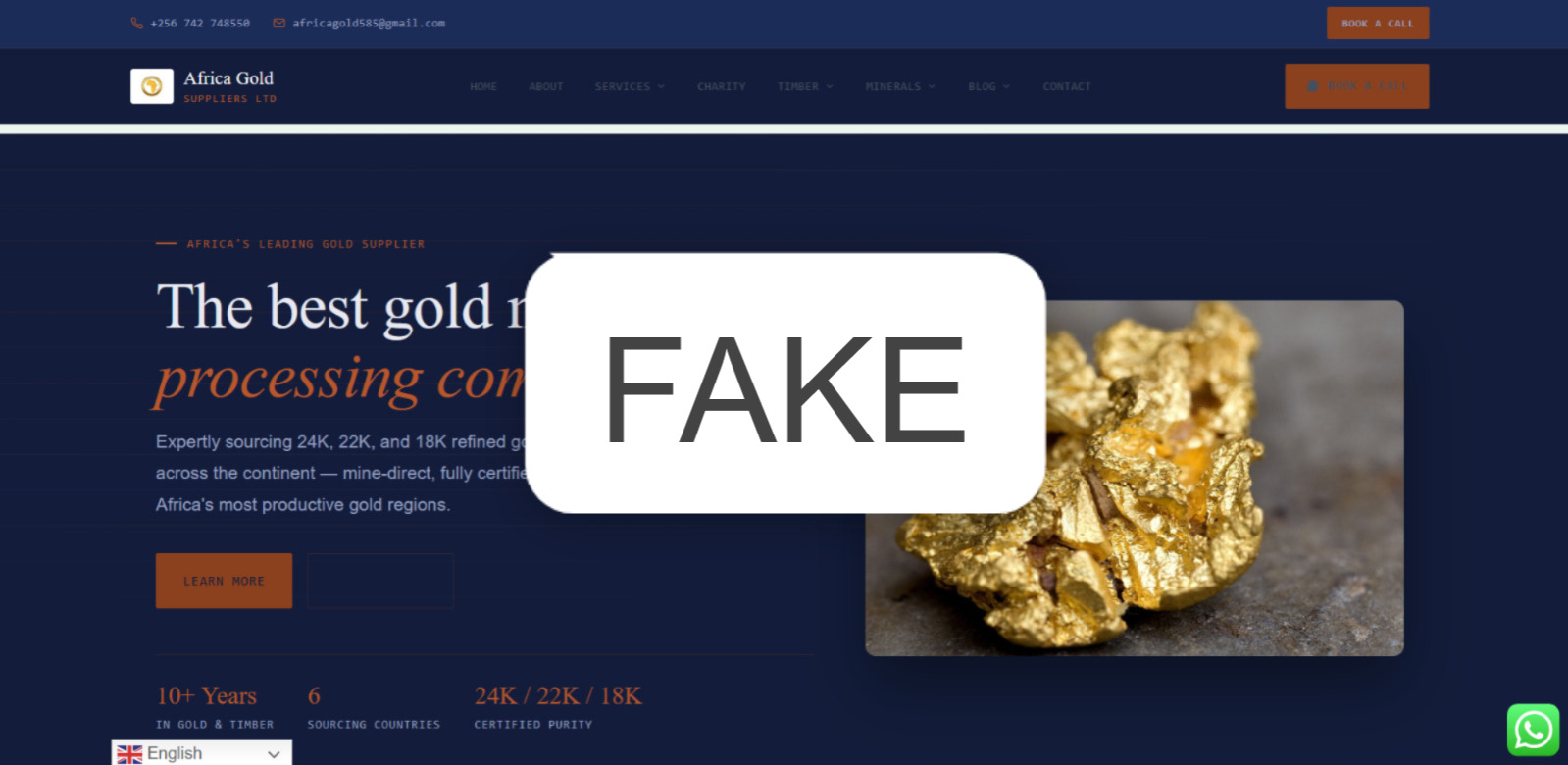
If you are searching “Is Africa Gold Suppliers real or scam?”, you are probably weighing a serious purchase and want a straight answer. The website africagoldsuppliers.com presents “Africa Gold Suppliers Ltd” as a licensed gold dealer and exporter. Many of its pages are written to appear in searches such as “buy gold near me” and “African gold bars for sale.”
This guide does not invent a verdict. It sets out what the website claims, what we were able to check, what we could not confirm, and the exact steps you can take to verify the company yourself before sending any money. It is published by Colomine Mining Corporation (COMINCOR SA), a Cameroon-focused gold business. We are in the same industry, so we have tried to stick to publicly visible facts and to be fair.
Our assessment: unverified. In the searches we ran in October 2026, we found no independent confirmation of the company’s registration, mining or export licences, or completed deliveries. We also did not find specific scam reports naming this domain, although our search was limited. The website’s own descriptions of the business are inconsistent in places. We are not alleging fraud. Until you verify the company yourself, treat it as unverified and do not pay any deposit, fee or “permit” in advance.
Key Takeaways
- “Real” and “scam” are not the only possibilities. A business can exist and still be an intermediary, an unlicensed trader or a poor performer.
- The company’s own website is marketing. It is not proof of licences, mines or deliveries.
- Several details on the site conflict with each other, such as where the company is based and where it operates. Ask the company to explain them.
- Verification means independent checks: company registry, regulators, assay, references and a protected payment structure.
- The same checklist applies to every gold supplier, including us.
What We Reviewed, and the Limits of This Review
We read publicly available pages on africagoldsuppliers.com and ran web searches for independent reviews, scam reports and registry information. We did not contact the company, buy anything or test any gold. We have no inside knowledge of the business.
- What this review can do: summarise public claims, highlight inconsistencies and show you how to check.
- What it cannot do: prove that the company is genuine or fraudulent. Only checks against registries, regulators and your own testing can do that.
- Time sensitivity: websites change. Check the current pages and any documents you are given.
What the Africa Gold Suppliers Website Says
These are the website’s own claims, summarised in our words. They are not confirmed facts.
| Topic | What the website claims |
|---|---|
| Business type | A gold and timber company, described on some pages as based in Uganda and on others as a gold dealer based in the DRC |
| Registration | Says it is registered under a company law, with a stated history of about ten years |
| Operations | Says it owns or operates gold mines in Uganda and the DRC, and that it mines, smelts and ships gold |
| Countries | Different pages list different sets of countries, with one page including Cameroon and others not |
| Sourcing | Mentions Mali, Kenya, Congo, Ghana, Sudan, Zimbabwe and Tanzania, with “direct partnerships” with miners and cooperatives |
| Licences | Describes itself as fully licensed and a licensed exporter, without publishing licence numbers on the pages we reviewed |
| Payment safety | Says it works on a zero advance-fee basis, with documentation verified before funds are released |
| Traceability | Mentions assay-tested bars and blockchain-tracked provenance |
| Contact | Free Gmail addresses are listed on the pages we reviewed |
What We Could and Could Not Verify
| Check | Result of our review |
|---|---|
| Registration number and registry entry | Not found on the pages we reviewed. You should ask for it and check the registry. |
| Mining or dealer licence numbers | Not published on the pages we reviewed. Ask for them and verify with the regulator. |
| Export authorisations | Claimed, not documented publicly. |
| Physical address and site | No verifiable street address found on the pages we reviewed. |
| Named directors or officers | None found on the pages we reviewed. |
| Independent reviews or press coverage | None found in our searches. Absence of reviews is not proof of anything, but it leaves you without outside evidence. |
| Specific scam reports against this domain | None found in our searches, which were limited. |
Important: “We could not verify it” is different from “it is fake.” A genuine small company may simply not publish its documents. But a buyer should not send money on the basis of unpublished documents. Ask for them and check them independently.
Points That Deserve Questions
None of the points below proves wrongdoing. Each is simply something a careful buyer should ask the company to explain.
1. Where is the company actually based and licensed?
The site describes the business in different ways: a Uganda-based gold and timber company, a DRC-based dealer, and a multi-country operator. Gold regulation differs sharply between Uganda, the DRC, Ghana, Tanzania, South Africa and Cameroon. Which entity holds which licence, and where?
2. Which country list is correct?
One page lists Cameroon among its operating countries and others do not. If you are buying in Cameroon, ask for the specific authorisation that covers Cameroonian gold, and verify it with the Ministry of Mines.
3. Is it a miner, a dealer or a reseller?
The site says it owns mines, but it also describes buying from cooperatives and partners across many countries. These are different business models with different risks. A mine owner can show permits and production records. A reseller must show where its gold comes from and who authorised each sale.
4. Is the claimed link to well-known mines documented?
One page presents the company as sourcing from the Kibali area in the DRC and selling very small bars to retail buyers. Large industrial mines normally sell through formal refining and offtake arrangements. Ask for written proof of any partnership, and verify it directly with the mine operator or the cooperative involved.
5. Why are no licence numbers or named officers shown?
Transparent operators usually make licence numbers, registered address and key officers easy to find. If they are not public, request them in writing before any discussion of price.
6. What is the claim of “blockchain-tracked provenance” based on?
Blockchain records can only be as reliable as the data entered into them. Ask which system is used, who audits it and whether you can verify a specific bar or lot yourself.
7. How should you read “best dealers” lists on the company’s own site?
Some pages on the website rank “best dealers” or “best companies” for buying or transporting gold, and list the company itself first. These are marketing pages written to rank in search engines, not independent reviews. They should carry no weight in your decision.
8. Is a free email address acceptable?
Many small businesses use Gmail, so this is not proof of anything. But for a company claiming multi-country licensed export operations, you should expect a business domain email and verifiable named contacts, and you should treat the absence as one more reason to verify carefully.
Is Africa Gold Suppliers Real or Scam? Three Possible Explanations
Rather than force a yes-or-no verdict, it helps to consider what the evidence could mean.
| Scenario | What you would expect to see | Risk to you |
|---|---|---|
| A genuine, licensed operator | Registry entry, licence numbers, named directors, willingness to be audited, third-party assay, references | Low once verified |
| A genuine business acting as an intermediary or reseller | Real company, but unclear sourcing, no mines of its own, reliance on partners | Medium: provenance and authorisation gaps |
| A fraudulent or fictitious operation | No verifiable registration, pressure for upfront fees, refusal of independent testing or site visits | Very high: loss of funds |
You cannot tell which row applies by reading a website. You find out by asking the right questions and checking the answers independently. The sections below show you how.
Why Generic Names Need Extra Care
“Africa Gold Suppliers,” “African Gold Company” and similar names are descriptive, not distinctive. That creates three problems. Genuine companies can share similar names. Impostors can copy a real business’s name, logo and documents. And search results for a generic name can mix up unrelated businesses. Is Africa Gold Suppliers Real or Scam?, Always verify the exact legal entity, registration number and registered address, and contact the company through details you found independently rather than those supplied in a message.
How to Verify Africa Gold Suppliers Yourself, Step by Step
Use this process for this company or any other gold supplier. It follows the principles of the OECD Due Diligence Guidance for Responsible Supply Chains of Minerals.
Step 1: Get the legal identity in writing
Ask for the exact registered name, registration number, registered address, directors, shareholders and tax ID. Insist that these match on every document, invoice and bank detail.
Step 2: Check the company registry
Verify the registration with the registry of the country where the company says it is incorporated. For a Ugandan company, that means the Uganda Registration Services Bureau. For a South African company, the CIPC. For Cameroon, use a local lawyer to check the commercial registry. If no registry entry exists, the conversation is over.
Step 3: Verify licences with the regulator
| Country claimed | Who to ask |
|---|---|
| Cameroon | The Ministry of Mines, Industry and Technological Development (MINMIDT), plus a Cameroonian lawyer |
| Uganda | The ministry responsible for minerals and its mining regulators |
| DRC | National mining authorities and a DRC-qualified lawyer, because artisanal mineral exports involve state certification steps |
| Ghana | The Minerals Commission and the state body overseeing gold trading |
| South Africa | The precious metals regulator, with advice from a South African attorney |
Use contact details you found yourself. Ask the regulator to confirm the licence number, holder, scope and expiry date in writing.
Step 4: Hold a live video call
Meet the named directors on video. Ask them to show their office, sign-in documents and, if they claim a mine, the site. Cross-check the people you meet against registry records.
Step 5: Trace provenance and screen for risk
Request mine or collection-site records, chain-of-custody documents and export papers. Screen the company and its owners against sanctions lists such as OFAC, and apply anti-money-laundering controls consistent with FATF standards. Refiners follow the LBMA Responsible Gold Guidance.
Step 6: Test the gold independently
Choose an accredited laboratory or refinery yourself, take and seal samples under your own control and insist on fire assay. Seller-supplied certificates alone prove nothing.
Step 7: Test the “zero advance fee” promise
The company says it takes no advance fees. Hold it to that. If at any stage you are asked to pay a deposit, “permit,” “tax,” “clearance” or “insurance” fee before independently verified gold is in your control, stop. Be especially alert to requests tied to a so-called CEMAC buyers permit, which has been a recurring scam pattern.
Step 8: Structure payment safely
Use bank-to-bank payments to a verified corporate account in the company’s exact legal name, ideally through escrow or documentary credit released against independent assay. Never pay to personal accounts, cash agents or crypto wallets.
Questions to Put to the Company in Writing
- What is your exact registered name, registration number and registered address?
- Who are your directors and beneficial owners?
- Which licences do you hold (number, issuer, scope, expiry), and in which country?
- Do you own or operate a mine, and if so, where, and under which permit?
- Where does the gold you sell come from, and who authorised its sale and export?
- Which refinery, laboratory or inspection company will test the gold, and will you accept my choice?
- Can I speak to two or three past buyers who completed deliveries?
- Will you accept escrow or payment against independent assay, with no advance fees?
How the company answers can be as informative as what it says. Clear, specific, documented answers are a good sign. Vague replies, delays, pressure or hostility are not.
Expert insight: The most reliable single test is whether a supplier welcomes verification. Honest operators expect due diligence and often prepare for it. Fraudulent ones tend to discourage independent checks, rush you toward payment, or move the discussion to private messaging apps.
General Red Flags on Gold Supplier Websites
- Dozens of near-identical pages targeting search phrases like “buy gold near me” or “gold bars for sale” in many countries.
- Claims of operating in many countries with no licence numbers or regulator references.
- No named directors, no physical address, only free email addresses.
- Prices at or below spot, or unusually large stock available immediately.
- Self-ranking “best dealer” lists or “reviews” written by the company.
- Requests for upfront fees, deposits or “release” costs.
- Refusal of independent assay, site inspection or video calls.
- Inconsistent stories about location, ownership or operations.
Several of these are features of many marketing-led websites, genuine or not, so no single item decides the matter. Several together, with no independent verification, should make you pause. Warnings about gold-deal fraud in Africa have been published for years, including prosecutions over forged mineral export permits, such as a case reported by Business Daily Africa.
If You Plan to Buy Gold in Cameroon
Is Africa Gold Suppliers Real or Scam?, Cameroon’s gold sector is under heavy regulatory pressure in 2026. Government statements reported in the press describe roughly 200 operators identified as acting illegally, mainly in the East and Adamawa regions, according to Business in Cameroon. Dozens of exploration permits were reportedly revoked, per Financial Afrik. In that climate, any company claiming Cameroonian operations should be able to show current authorisations that the Ministry of Mines will confirm. Read our guides on gold suppliers in Cameroon and how to verify a Cameroon gold seller for detailed checklists.
Common Mistakes Buyers Make
- Treating a professional-looking website as proof. Anyone can build one in a day.
- Relying on reviews published by the company itself. Seek independent sources.
- Skipping the registry search because the company “has been operating for ten years.”
- Accepting documents without checking issuers. Certificates and licences can be forged.
- Paying a “small” deposit to secure the price. It is the most common entry point for loss.
- Assuming a lack of scam reports means safety. New schemes have no reports yet.
Best Practices Before Any Gold Purchase
- Verify the company at the registry and the licences at the regulator, using contacts you found independently.
- Hire your own lawyer and your own assay or inspection firm.
- Put every term in a written contract reviewed by counsel.
- Start with a small, fully verified transaction before scaling.
- Keep a complete record: registry extracts, licence confirmations, assay reports, payments and correspondence.
- If you suspect fraud, report it to your bank and the police, and to agencies such as the FBI’s IC3 if you are in the United States.
Already Dealt With Africa Gold Suppliers?
If you have bought from, or been asked to pay, this company, your experience matters, whether good or bad. Keep all records, and if you have lost money, contact your bank immediately and report to law enforcement. Be careful with anyone offering to “recover” your funds for a fee, which is a known second-stage scam. If the company wishes to provide registration, licence or audit documents for us to review, we will consider updating this article.
Our Position at Colomine Mining Corporation
We apply to ourselves the standards in this guide. Prospective partners should verify Colomine Mining Corporation’s registration and authorisations directly, involve their own advisers and proceed only when satisfied. Visit the Colomine Mining Corporation website and use the official contact details published there. We do not ask for upfront fees.
Related searches covered: africagoldsuppliers.com legit, Africa Gold Suppliers Ltd reviews, Africa Gold Suppliers Uganda, African gold bars for sale scam, gold suppliers in Africa, buy gold from Africa safely, how to verify a gold supplier, gold dealer red flags.
Frequently Asked Questions
1. Is Africa Gold Suppliers real or scam?
We could not verify it either way. The website makes licensing and operating claims we could not confirm independently, and some are inconsistent. We are not alleging fraud. Verify the company yourself before paying anything.
2. Is africagoldsuppliers.com legit?
Treat it as unverified. Check the company registry, regulator licences, named directors and independent assay results before any payment.
3. Where is Africa Gold Suppliers Ltd based?
Its website describes it as Uganda-based on some pages and DRC-based on others. Ask the company for its registered address and registration number, and verify them at the registry.
4. Does Africa Gold Suppliers operate in Cameroon?
One page of its website lists Cameroon; others do not. Ask for the specific authorisation and confirm it with Cameroon’s Ministry of Mines.
5. Are there reviews of Africa Gold Suppliers?
We found no independent reviews in our searches. Self-published “best dealer” pages on the company’s own site are marketing, not reviews.
6. How can I check if a gold company is registered?
Search the official company registry of the country where it claims to be incorporated, or hire a local lawyer to do so, and confirm that the name, number, address and directors match.
7. Is a Gmail address a sign of a scam?
Not by itself, but a company claiming licensed multi-country exports should have a business domain and named contacts. Treat it as one reason to verify more carefully.
8. What does “zero advance fee” mean, and can I rely on it?
It means no payment before delivery or verification. Hold the company to it, and walk away if any deposit, tax, permit or clearance fee is requested in advance.
9. How do I test gold safely?
Use fire assay at an accredited lab or refinery you choose, with samples sealed and shipped under your control. Do not rely on the seller’s certificate.
10. What is the safest way to pay a gold supplier?
Bank-to-bank to a verified corporate account, ideally via escrow or documentary credit released after independent assay. Avoid cash, crypto and personal accounts.
11. What should I do if I already paid?
Stop paying, call your bank to attempt a recall, keep all evidence and report to the police and fraud agencies. Beware of “recovery” offers.
12. Are generic names like “Africa Gold Suppliers” a problem?
They make impersonation easy and searches confusing. Always verify the exact legal entity, registration number and address, and use independently sourced contact details.
Conclusion: Verify First, Then Decide
So, is Africa Gold Suppliers real or scam? On the public evidence we reviewed, the honest answer is that it is unverified. That is not a finding of fraud, and it is not a clean bill of health. It means the burden is on the company to prove itself, and on you to check before you pay. Ask for the registration, the licences, the named directors and the independent assay. If the company welcomes those checks, you will learn a great deal. If it resists them, you will learn even more.
If you want to source gold with a transparent, documented process, contact Colomine Mining Corporation through our official website. Bring your advisers and your checklist. We welcome both.