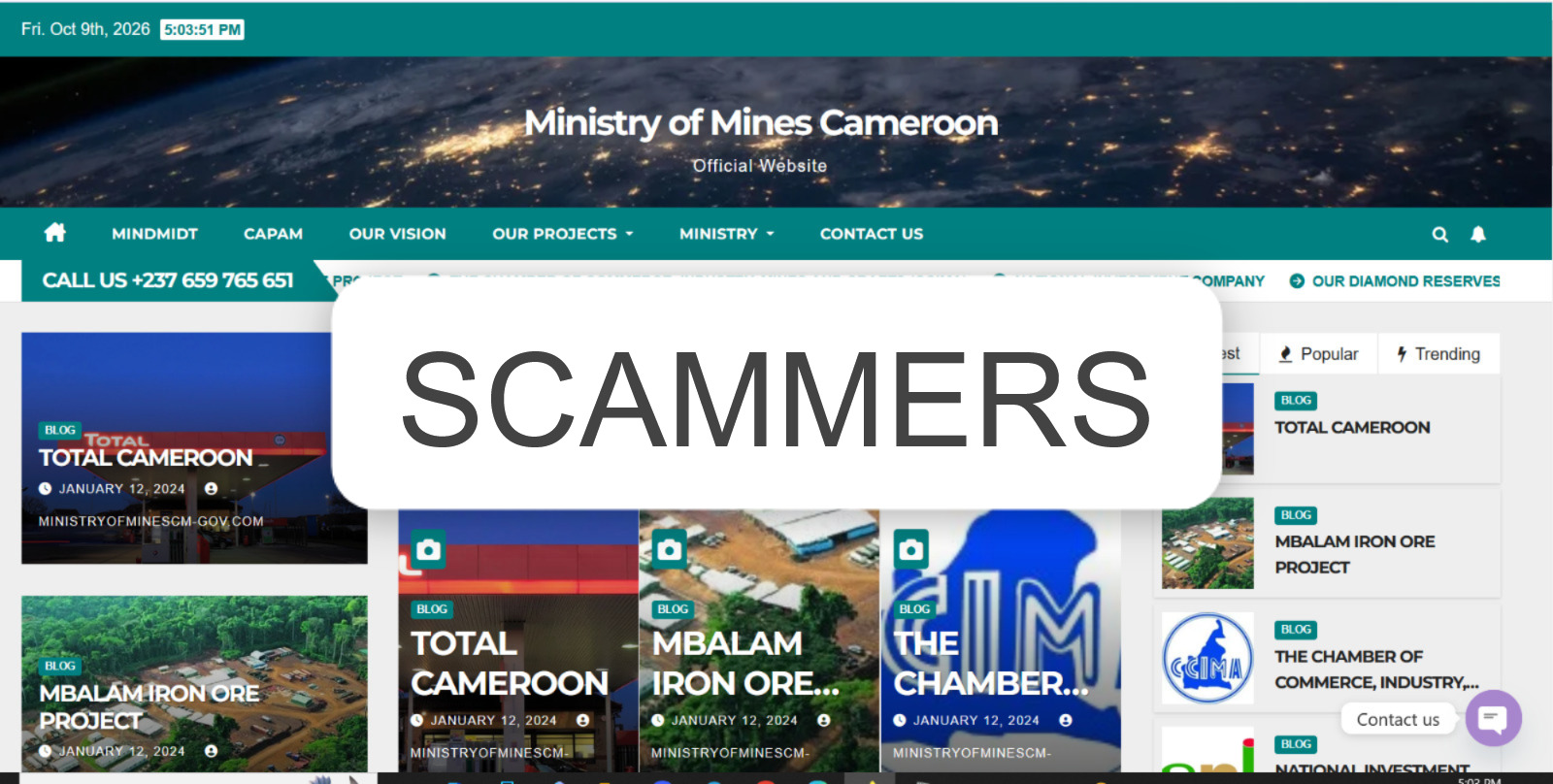
Fake Ministry of Mines Cameroon Websites: How the Gold Permit Scam Works
Every year, buyers around the world lose money to fake Ministry of Mines Cameroon websites and the forged documents they support. The pattern is simple. A “seller” offers gold at an attractive price, then sends you to an official-looking website, a stamped letter or a “ministry officer” who confirms that the deal is legal. Before the gold can move, you are asked to pay one more fee: a permit, a tax, an escrow charge or an export certificate. The gold never arrives, because it never existed.
This guide explains how the scam works, how to recognize fake government websites, how to verify the real mining authority, and what to do if you have already been targeted. It is written for gold traders, jewelry manufacturers and consumers, institutional investors, central-bank and treasury analysts, and industrial buyers of precious and strategic metals.
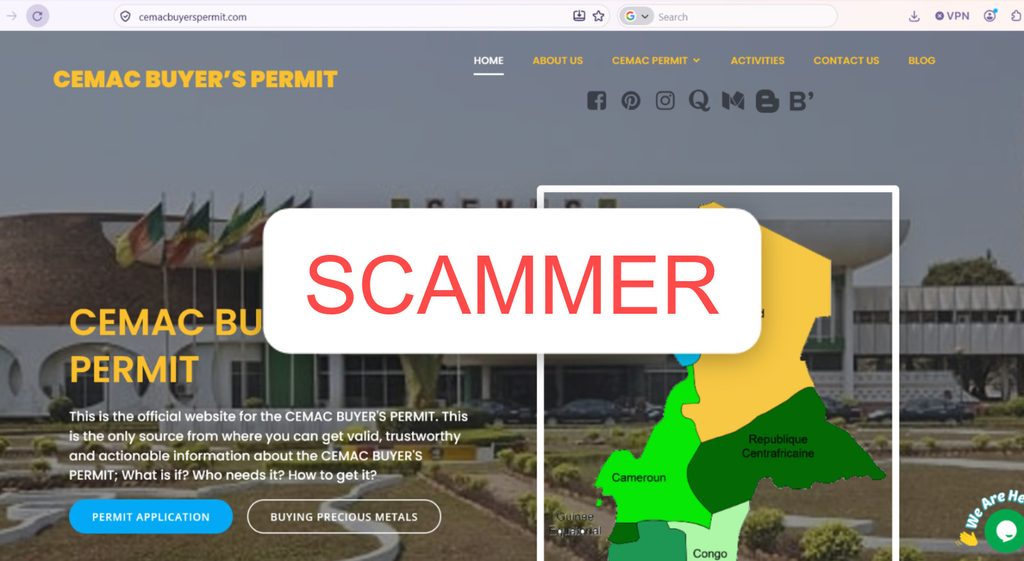
Quick answer: A fake ministry of mines website is a lookalike or invented site that imitates a government mining authority to make a gold deal seem legitimate. The scam usually ends with an upfront payment for a permit, tax or clearance. Fake Ministry of Mines Cameroon Websites, Never pay a fee or trust a document until you have verified it directly with the real authority through contact details you found independently.
Key Takeaways
- Scammers copy logos, layouts and official wording, so a professional look proves nothing.
- The money request almost always comes after “verification”: an export permit, a tax clearance, a certificate or an escrow deposit.
- Real gold buyers verify the title, the seller and the paper trail before paying anything.
- Contact the real ministry using details you found yourself, never details supplied by the seller.
- The same playbook is used for fake crypto mining platforms, fake miners and social media offers.
- If you paid, act quickly: contact your bank, preserve evidence and file reports with the right agencies.
Why Fake Mining Ministry Websites Work
Gold trading has three features that fraudsters exploit. First, the market is global, so buyers often deal with sellers in countries they have never visited. Second, the rules are genuinely complex: mining titles, export procedures and taxes vary by country, so a buyer may not know what is normal. Third, gold is valuable and easy to describe, so a promise of discounted supply is emotionally convincing.
A Fake Ministry of Mines Cameroon Websites solves the scammer’s biggest problem: trust. Instead of asking you to believe the seller, the scammer points you to an apparently independent authority that confirms everything. In reality, the seller controls both sides of the conversation.
How the Gold Permit Scam Works, Step by Step
The details vary, but most cases follow a recognizable script.
- The approach. You receive a message through email, WhatsApp, LinkedIn or a Facebook group offering gold, often below market price and often “from a mine in Cameroon.”
- The credentials. The seller sends photos of gold bars, assay reports, passports and licence copies. Many are stolen from real companies or edited.
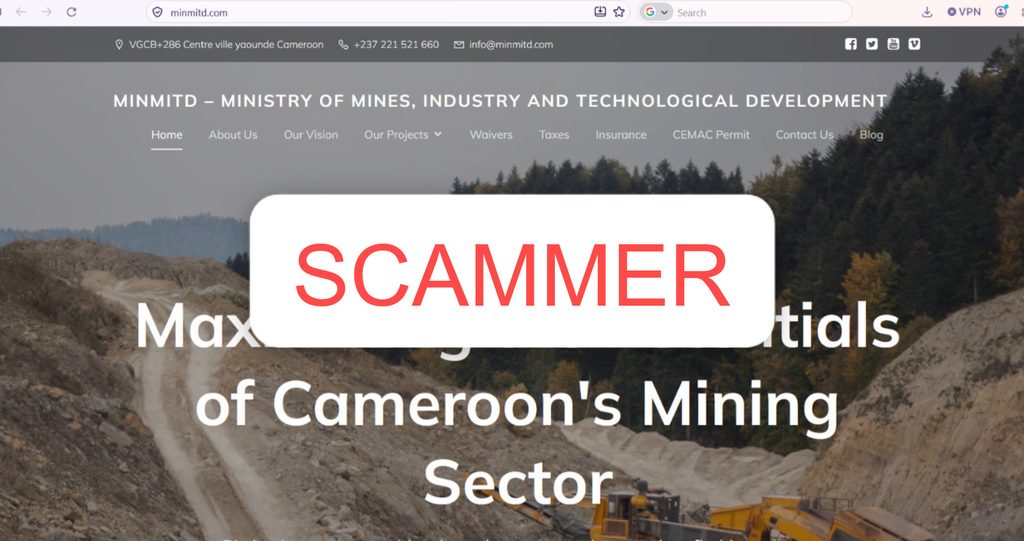
- The “ministry” confirms. You are given a link to a website, a PDF letter or an email address that appears to belong to the Ministry of Mines. It confirms the seller’s licence and the legality of the sale.
- The urgent fee. A “problem” appears: the export permit has not been paid, a tax certificate is missing, or an escrow account must be funded. The sum is small compared with the deal, so paying seems reasonable.
- More fees follow. Once you pay, new obligations appear: customs, insurance, a courier clearance, a “ministry inspection.” Each is presented as the last step.
- The disappearance. When you stop paying or ask hard questions, communication ends, or you are pressured with threats or fake legal notices.
Typical fake documents and fees
| Fake item | What the scammer says | Reality |
|---|---|---|
| “Export permit fee” | The ministry will not release the gold until you pay | Legitimate permits are processed by the exporter through official channels, not by a buyer wiring money to a personal account |
| “Gold origin certificate” | You must buy a certificate from the ministry | Certificates are issued under formal procedures to authorized parties |
| “Escrow deposit” | A neutral account will protect you | The escrow is controlled by the scammer or a fake law firm |
| “Ministry inspection” | An officer must travel to inspect the gold | An invented expense to extract more money |
| “Tax clearance letter” | You owe a tax before shipment | Taxes are not collected through private messaging or personal bank accounts |
Red Flags on a Fake Ministry of Mines Website
No single sign is conclusive. Together, they build a strong case. The following checks apply whether you see a fake ministry of mines Cameroon website or a fake government page in any other country.
Domain and technical signals
- Unusual domain. Government sites normally use a government or country-code domain. A “.com,” “.org,” “.info” or hyphenated lookalike for a ministry is suspicious. Confirm what the real domain is from an independent official source.
- New domain registration. Look up the domain’s age with a WHOIS or ICANN lookup. A government site registered a few weeks ago is a warning.
- Free webmail contact. Officials who use Gmail, Yahoo or Outlook addresses for ministry business are not likely to be real.
- A padlock is not proof. HTTPS only means the connection is encrypted. Scammers can obtain certificates easily. See the MDN explanation of secure contexts for what HTTPS does and does not guarantee.
- Copied or stolen content. Pasted text, broken links, low-resolution logos and mismatched fonts are common.
Content and behavior signals
- Payment pages. A real ministry does not run a web form that collects “gold deal fees” from foreign buyers.
- Personal bank or crypto wallet details. Government fees are not paid to individuals.
- Perfect confirmation of one seller. If the site exists only to vouch for a single deal or company, it is a prop.
- Pressure and secrecy. “Pay today or lose the allocation” and “do not contact anyone else” are classic manipulation tactics.
- Inconsistent address and logo details. A fake ministry of mines Cameroon address may list a street that does not exist, a phone number from another country or a generic email. A fake ministry of mines Cameroon logo may be a low-quality copy or an outdated version.
Golden rule: Never verify a document using the contact details printed on that same document. Find the authority’s contact information independently, through an official government portal, an embassy or a trusted legal adviser.
How to Verify the Real Authority in Cameroon
In Cameroon, mining is overseen by the Ministry of Mines, Industry and Technological Development (MINMIDT), under the Mining Code (Law No. 2016/017 of 14 December 2016). Our companion article, MINMIDT Cameroon Explained, describes what the ministry does and how titles and the mining cadastre work. Fake Ministry of Mines Cameroon Websites, Ministry names can change after government reshuffles, so confirm current details through official channels.
A practical verification routine
- Find the official website independently. Navigate from the Government of Cameroon’s main portal or an embassy site, not from a link sent by the seller.
- Check the mining cadastre. Confirm that the claimed licence exists, that the holder name matches the seller and that the perimeter and validity dates are correct.
- Write to the ministry. Send a formal letter or email to contact details you found yourself, asking whether the permit number is valid and whether the person named is authorized.
- Check the company. Verify registration and tax identity through official company registries, a local lawyer or a reputable due-diligence provider.
- Inspect the gold independently. Use an independent assayer and a secure facility chosen by you, not by the seller.
- Use regulated payment methods. Prefer documented, traceable banking arrangements with a reputable bank or refinery. Avoid wire transfers to personal accounts and crypto payments for physical gold.
Cameroon Facebook Scams and Social Media Gold Offers
Searches for Cameroon Facebook scams reflect a broader trend: fraud groups use social media because it is cheap and fast. Common tactics include fake mining company pages, “verified” profile photos stolen from real people, private groups with fabricated testimonials and direct messages from friends whose accounts were hacked.
- Fake testimonials: Comments praising a seller are often created by the same operators.
- Moving the chat: Scammers push you quickly to WhatsApp or Telegram, where fewer protections exist.
- Impersonating officials: Accounts using a minister’s photo or a ministry logo are common. Government officials rarely negotiate private trade deals through social media messages.
- Recruitment variants: Fake mining job offers that request a “processing fee” are another version of the same fraud.
Fake Miners and Fake Crypto Mining Websites
The term fake miners covers two groups. The first are people who claim to own or control gold, diamonds or other minerals but do not. The second are impersonators who copy the identity of real mining companies. In both cases, the fraud depends on borrowed credibility.
A fake crypto mining website uses the same psychology with different bait: guaranteed daily returns, “cloud mining” contracts, dashboards showing growing balances and a withdrawal fee that must be paid before you can access your money. Fake Ministry of Mines Cameroon Websites, If the site shows profits but blocks withdrawals until you pay more, it is not mining anything. Be wary of unrealistic returns, anonymous operators and platforms that cannot explain where their hardware or energy supply is located.
Fake Ministry of Mines Websites in India, the USA and Canada
Searches such as “fake ministry of mines websites in India,” “in USA” and “in Canada” show that the problem is not limited to one country. Government authorities are impersonated everywhere, and each jurisdiction has a different structure. Knowing how your country is organized helps you spot impostors.
| Country | Who actually oversees mining | What to watch for |
|---|---|---|
| India | The Ministry of Mines (central government), with state mining departments | Lookalike sites offering licences, auction help or “clearances” for a fee. Government sites normally use official government domains. |
| United States | There is no single federal “Ministry of Mines.” Relevant bodies include the USGS, Bureau of Land Management, MSHA and state agencies | Anyone claiming to be a US “Ministry of Mines” is immediately suspect. A scam can still cite US agencies or embassies to appear credible. |
| Canada | Natural Resources Canada federally, and provincial ministries that regulate mining | Fake “federal mining ministry” pages and forged letters from provincial offices. |
| Central African Republic | A national ministry responsible for mines and geology (names change with governments) | Be careful with any “minister of mines Central African Republic” contact. Verify the office-holder and contacts through official government channels before responding. |
For “fake ministry of mines Cameroon 2023” and “2024” style searches, the lesson is that new fake pages appear continuously. A list of known bad domains goes out of date quickly, so building a verification habit is more reliable than memorizing site names.
Real vs. Fake: Quick Comparison
| Feature | Legitimate process | Typical scam |
|---|---|---|
| Contact channel | Official government email and offices found independently | Gmail or messaging apps supplied by the seller |
| Payments | Documented, traceable, to institutions or regulated counterparties | Personal accounts, crypto or cash couriers |
| Speed | Procedures take time and require paperwork | Urgent, immediate “approval” |
| Verification | Seller welcomes checks and site visits under proper conditions | Seller resists independent verification |
| Pricing | Close to market, adjusted for quality and logistics | Significantly below the spot price |
Expert Insights: What Professional Buyers Do Differently
Professional gold buyers do not rely on trust. Fake Ministry of Mines Cameroon Websites, They rely on process: verified title, verified entity, independent assay, controlled payment and documented chain of custody. When a deal asks you to skip steps, the deal is the problem.
- Refiners and traders: Work with counterparties who can satisfy responsible-sourcing standards such as those described by the LBMA and the OECD Due Diligence Guidance.
- Jewelry manufacturers: Buy from established refiners and recognized suppliers, not unsolicited offers.
- Institutions and central-bank analysts: Use regulated channels and recognized custodians. Gold reserves are not purchased through anonymous intermediaries. The World Gold Council publishes market and reserve-management research.
- Industrial buyers: Verify the producer, the processing route and the export documentation for strategic minerals as well as gold.
Common Mistakes That Lead to Losses
- Verifying through the seller’s own links. The “ministry” you contacted may be run by the scammer.
- Paying small fees. A modest first payment makes you less likely to walk away, a pattern known as sunk-cost pressure.
- Accepting a letter as proof. Logos, signatures and stamps are easy to forge.
- Skipping a lawyer. Local legal advice costs far less than a lost deposit.
- Trusting a price that is too good. Genuine sellers do not need to undercut the market by large margins.
- Keeping the deal secret. Share the offer with a trusted colleague or adviser. Fraud thrives on isolation.
Best Practices to Protect Yourself and Your Company
- Adopt a written policy: no payment before independent verification of title, entity and gold.
- Train staff on impersonation fraud, especially procurement and finance teams.
- Use dual approval for any payment related to precious metals.
- Bookmark official government portals instead of searching for them each time, and be careful with sponsored search results.
- Check domains carefully for lookalike spellings and new registrations.
- Keep records of all communications, documents and payment instructions.
- Consider using the Google Safe Browsing status check and your browser’s phishing protection as additional layers, not as a final verdict.
What to Do If You Were Targeted or Already Paid
- Stop paying. Do not send “recovery” fees. Recovery scams often target previous victims.
- Contact your bank immediately. Ask about a recall or fraud report; speed matters.
- Preserve evidence. Save emails, chat logs, website screenshots, invoices, wallet addresses and bank details.
- Report to authorities. In the United States, use the FBI Internet Crime Complaint Center (IC3) and the FTC. In Canada, use the Canadian Anti-Fraud Centre. In other countries, contact your national police or consumer-fraud agency.
- Notify Cameroonian authorities and your embassy. Report impersonation of a government ministry to the relevant authorities and the ministry’s official channels.
- Report the website. Submit the fake site to the hosting provider, the domain registrar and search engines using their abuse or phishing forms, including Google’s phishing report page.
Frequently Asked Questions
1. Is there a real Ministry of Mines in Cameroon? Yes. Cameroon has an actual Ministry of Mines, Industry and Technological Development (MINMIDT). The scam involves imitation websites, not the ministry itself acting fraudulently.
2. Do I need a permit from the Ministry of Mines to buy gold from Cameroon? Generally, no. Legitimate international gold purchases are not typically conditioned on the buyer personally obtaining a government permit purchased in advance. Treat any such requirement as a red flag and verify independently before paying anything.
3. What is a “CEMAC Buyer’s Permit”? It’s a document frequently referenced in these scams, purportedly required to trade gold or diamonds within CEMAC (Central African) member states. Its use in unsolicited online gold deals is a hallmark of this fraud pattern.
4. How can I tell if a Ministry of Mines website is fake? Check the exact domain spelling, look for official government contact channels rather than WhatsApp or free email accounts, and independently verify through an embassy or consulate rather than trusting links provided by the seller.
5. What should I do if I’ve already paid a fee to one of these sites? Stop all further payments immediately, gather your documentation (emails, payment records, website screenshots), and report the incident to your local fraud/consumer protection authority and your bank or payment provider as soon as possible.
6. Are all Cameroonian gold sellers scammers? No. Legitimate gold trade and mining activity exists in Cameroon. The issue is specifically with unsolicited online offers that require advance “permit” payments through unofficial websites.
7. Why do scammers use official-looking government branding? Because it builds trust quickly. Buyers are more likely to comply with a payment request when it appears to come from a government authority rather than a private individual.
8. Can I recover money sent to one of these scam sites? Recovery is often difficult, especially with international wire transfers. Reporting quickly to your bank, payment provider, and relevant fraud authorities gives you the best chance, though success isn’t guaranteed.
9. Are there other similar scams in the region? Yes. Similar “permit,” “certificate,” or “clearance” fee scams have been documented in connection with gold and diamond sourcing from several countries. The underlying pattern — an upfront fee required before goods are released — is common across many advance-fee fraud schemes.
10. Where can I verify claims about specific Cameroonian gold sellers or government sites? Independent, non-commercial fraud-tracking communities, your country’s foreign affairs or trade department, and Cameroon’s embassy or consulate are more reliable starting points than links or referrals provided by the seller.
Conclusion: Verify First, Pay Last
Fake ministry websites succeed because they borrow the authority of real institutions. The best defense is a disciplined process: independent verification, controlled payments, professional advice and a willingness to walk away when something feels rushed. Fake Ministry of Mines Cameroon Websites, Legitimate gold sellers expect scrutiny, and legitimate authorities never need you to pay through private channels.
Need verified, compliant sourcing information? Learn more about responsible mining and trade in Cameroon from Colomine Mining Corporation (COMINCOR SA), or contact our team for guidance before you commit to any deal.
Disclaimer: This article is general information and not legal, financial or investment advice. It does not accuse any named person or website of fraud. Always consult qualified advisers and official authorities.
Leave a Reply