Fake MINMIDT Websites: How to Spot a Fraudulent Mining License Portal
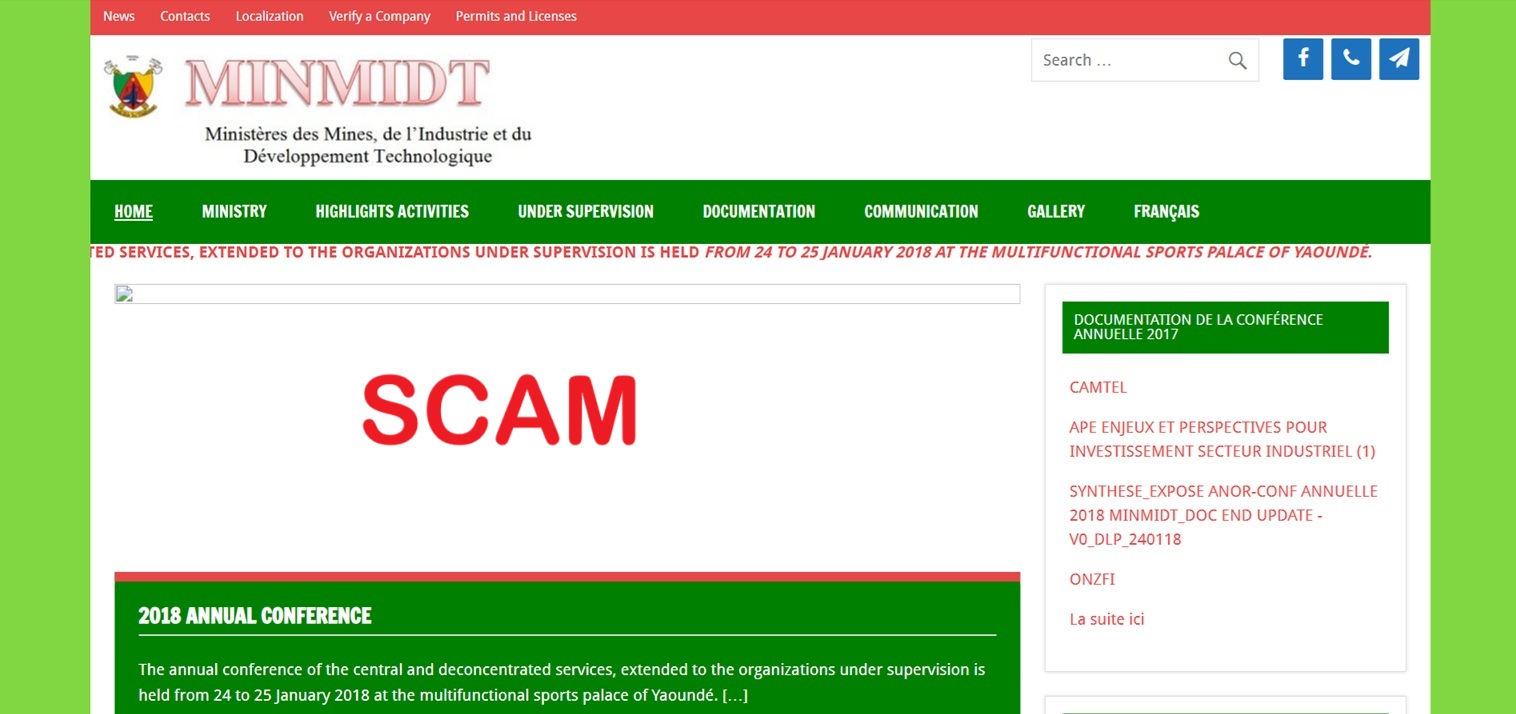
Fake MINMIDT websites are look-alike web pages, portals or email domains that imitate Cameroon’s Ministry of Mines, Industry and Technological Development (MINMIDT) in order to collect fees, steal personal data or give false comfort about a mining licence, export permit or gold deal. The safest defence is simple: never treat a website, email or PDF as proof of a licence until you have confirmed it through the ministry’s officially published channels.
Mining deals depend on paperwork. A licence number, a permit scan or a “verification link” can decide whether a buyer wires money or walks away. That makes government-branded pages an attractive disguise for fraudsters. A convincing logo, a coat of arms and a few official-sounding phrases can lower a buyer’s guard faster than any sales pitch.
This guide explains what MINMIDT actually does, how fake MINMIDT websites and fraudulent mining licence portals are typically built, the red flags you can check in minutes, and a step-by-step process for verifying any page before you rely on it. It is written for jewelry manufacturers and consumers, institutional investors and central banks, and high-tech industrial buyers who need dependable, traceable gold and minerals from Cameroon.
Key Takeaways for Fake MINMIDT Websites
- MINMIDT is the Cameroonian ministry responsible for overseeing the mining sector. Any website claiming to be MINMIDT must be proven genuine, not assumed.
- A padlock icon and “https” only show that a connection is encrypted. They do not prove the site belongs to the ministry.
- Be suspicious of any portal that asks you to pay “verification,” “registration” or “clearance” fees into a private account or crypto wallet.
- Never use the link, phone number or email address supplied by the person selling you the deal. Find the ministry’s contact details yourself.
- Confirm every mining title independently through the official channels and with a qualified Cameroonian lawyer.
- If a page is fake, preserve evidence, stop all payments and report it to your bank, national fraud authority and the browser and search providers.
What Is MINMIDT and Why Do Buyers Rely on It?
MINMIDT stands for the Ministère des Mines, de l’Industrie et du Développement Technologique, in English the Ministry of Mines, Industry and Technological Development. Fake MINMIDT Websites, it is the Cameroonian government body that oversees the mineral sector and helps shape mining and industrial policy.
Buyers, investors and suppliers look to the ministry because mining titles, authorizations and sector rules ultimately trace back to it. That is exactly why fraudsters like to impersonate it.
The Legal Framework Behind Mining Licences in Cameroon
Cameroon’s mining sector is governed by the Mining Code adopted as Law No. 2023/014 of 19 December 2023, supported by implementing decrees issued in late 2024. Earlier rules, including the previous mining code, are often cited in older articles, so buyers should confirm which texts apply to a given title or transaction with local counsel.
Our guide on sourcing gold from Cameroon and the legal requirements buyers should know explains how permits, authorizations and export rules fit together.
The Move Toward a Digital Mining Cadastre
Cameroon has been modernizing how mining rights are recorded. The World Bank-supported Mining Sector Capacity Building Project (PRECASEM) set out to deliver a computerized mining cadastre, and recent reports describe the ministry placing the national mining cadastre and geological information online as part of a wider transparency effort.
This is good news for buyers, but it also has a side effect. Fake MINMIDT Websites, as more government services move online, people grow used to click portals, and fraudsters can exploit that habit with convincing copies.
How Fake MINMIDT Websites Work
Fake government sites follow a well-known playbook that is used against ministries, tax offices and regulators worldwide. We do not publish names of suspected operators, and we have not compiled a verified list of fraudulent domains. Instead, this section describes the techniques so you can recognize them whatever the website is called.
1. Look-Alike Domain Names
The simplest method is to register a domain that resembles the real one: an extra hyphen, a swapped letter, a different ending such as .com, .org or .info, or additions like “portal,” “licence” or “verify.” Visitors who recognize the ministry’s name may not notice the small difference.
2. Cloned Pages and Copied Branding
Anyone can copy a page’s text, logo and layout in minutes. A cloned site may reuse real ministry photographs, official names, minister titles and even genuine legal texts, which makes the page look credible while key details, such as contact numbers or payment instructions, are quietly changed.
3. Fake “Licence Verification” Portals
A seller sends a link and says, “Verify our licence here.” The page shows a search box and always returns a green “valid” result for the licence number the seller supplied. Because the site is controlled by the fraudster, the answer is guaranteed.
4. Fake Online Application and Payment Pages
These pages invite applicants to “apply for an export permit,” “renew a mining title” or “register as a gold buyer,” then request an application fee, often through a bank transfer to an individual, a mobile-money number or a crypto wallet. After payment, the victim receives a forged PDF or nothing at all.
5. Spoofed Email Addresses and Messaging Accounts
A fake site is often paired with an email address using a look-alike domain, or with a free webmail account that has the ministry’s name in it. Messaging-app profiles using official photos can add pressure and a false sense of authority.
6. Forged Documents With Fake QR Codes
Forged permits and certificates may include QR codes or short links that lead to the fake portal. A document that “verifies itself” through a link printed on that same document proves nothing.
7. Search Ads and Social Media Promotion
Scam sites can be promoted through paid search ads, social posts or sponsored messages, which makes them appear near the top of results. A top position is not an endorsement. Always check the full address before you click or enter any information.
12 Red Flags of a Fraudulent Mining License Portal
No single sign proves a site is fake, but several together should stop you. Use this table as a quick screening tool.
| # | Red Flag | Why It Matters |
|---|---|---|
| 1 | Domain differs from the ministry’s official address | Look-alike domains are the foundation of impersonation |
| 2 | Link was sent by the seller, broker or “agent” | The party with the most to gain controls the evidence |
| 3 | Asks for payment to a personal account, mobile-money number or crypto wallet | Government fees are not normally paid this way |
| 4 | Email addresses use free webmail or a different domain | Official communication generally uses the institution’s own domain |
| 5 | Newly registered domain | Fraud sites are often created shortly before use |
| 6 | Poor translation, inconsistent French and English, spelling errors | Cloned or rushed content often has language mistakes |
| 7 | Urgent deadlines or “limited-time” clearance | Pressure prevents independent checks |
| 8 | Always returns “valid” for any licence number | Indicates a scripted fake verification tool |
| 9 | No verifiable physical address, phone number or named office | Anonymous sites cannot be held accountable |
| 10 | Requests passport scans, bank logins or personal data upfront | Possible identity theft or phishing |
| 11 | Documents contain inconsistent dates, stamps, names or numbering | Typical of forged permits |
| 12 | Contact details cannot be confirmed from an independent source | Real institutions can be reached through published channels |
Technical Checks Anyone Can Run in Five Minutes
You do not need to be a security expert to catch many fake MINMIDT websites. These checks are quick and free.
Read the Full Web Address Carefully
Look at the part of the address just before the first single slash. That is the domain that matters. Anything before the domain, such as a ministry name used as a subdomain on an unrelated site, can be misleading. Cameroon’s country-code domain is .cm, and official Cameroonian government sites typically use it, although a .cm ending alone does not prove a site is genuine.
Do Not Trust the Padlock Alone
Encryption protects data in transit between your browser and a server. It does not tell you who runs the server. Free certificates are available to anyone, including fraudsters. For a technical explanation, see Mozilla’s documentation on Transport Layer Security.
Check When the Domain Was Registered
Use a registration lookup such as the ICANN Lookup tool to see when a domain was created. A government portal presented as long-established but registered a few weeks ago deserves scrutiny. Some registries redact owner details, so use age as a clue, not as proof.
Inspect Email Sender Details
Check the actual sending address, not only the display name. Watch for subtle spelling changes, free webmail services and mismatched “reply-to” addresses. If a message pressures you to act urgently or to change payment details, verify it by phone through an independently sourced number.
Compare Against a Trusted Reference
Intergovernmental and public directories often list official websites and contact details for national ministries. Cross-check the address you were given against at least one such independent source, and against the official web address you find yourself rather than one supplied in a message.
Rule of thumb: A genuine ministry can be reached through channels that you discovered, not channels that were handed to you by someone with a deal to close.
How to Verify a Mining Licence Portal: 8 Steps
- Stop and do not click. Do not enter data, upload documents or pay anything through a link you received in a message.
- Find the ministry yourself. Search independently for MINMIDT, use an official government directory or an international organization’s country contact listing, and compare the web address with the one you were sent.
- Check the domain. Review the spelling, the ending and the registration date, and look for look-alike variants.
- Use the official cadastre or registry yourself. Search for the licence number through the official channel you located in step 2, not through the seller’s link.
- Confirm by phone or in writing. Contact the ministry using details published on its official site and ask whether the title, holder name, validity dates and permitted substances match what you were shown.
- Hire local counsel. A Cameroonian lawyer or a reputable local due diligence firm can confirm the title status, renewals, overlaps and any restrictions.
- Cross-check the holder. Make sure the company that appears on the licence is the same legal entity that is selling to you, and verify its registration and directors.
- Document everything. Keep screenshots, dates, URLs and confirmations in your compliance file before any funds move.
Genuine Government Portal vs Fake MINMIDT Website
| Feature | Genuine Government Portal | Fake MINMIDT Website |
|---|---|---|
| How you found it | Through an official channel you located independently | Through a link from a seller, ad or unsolicited message |
| Payments | Through documented, official channels with official receipts | To individuals, mobile-money wallets or crypto |
| Contact details | Consistent across official publications and directories | Only exist on the suspicious site |
| Verification results | Reflect real records, including “not found” results | Always positive for the number supplied |
| Tone | Neutral and procedural | Urgent, promotional or secretive |
| Uses the institution’s domain | Free webmail or look-alike domains |
Why This Matters for Each Type of Buyer
Jewelry Consumers and Manufacturers
For jewelers, a forged permit is more than a legal risk. Fake MINMIDT Websites, if gold of unclear origin enters your supply chain, it can damage brand trust and trigger customer or regulator scrutiny. Verify licences and use refiners or suppliers that provide documented origin and assay results. Our safe buyer’s checklist for gold from Cameroon lists the documents to request.
Institutional Investors and Central Banks
Institutions face reputational, sanctions and anti-money-laundering exposure. A fraudulent licence portal can be used to make a non-existent concession look bankable. Independent legal opinions, registry confirmation and enhanced due diligence should be standard before any commitment.
Technology and Industrial Manufacturers
Industrial buyers increasingly need responsible-sourcing evidence for audits and customers. A fake licence undermines that evidence. Tie each lot to verifiable title, production and transport records.
Expert Insights: What Experienced Compliance Teams Do
- They verify the channel before the content. Before checking whether a licence is valid, they confirm that the place they are checking it is real.
- They look for negative results. A real registry can say “not found” or “expired.” A tool that never says no is not a registry.
- They treat QR codes as links. A QR code is only a shortcut to a web address and deserves the same scrutiny.
- They never let a deal timeline set the verification timeline. If a counterparty says verification must happen today, that is information about the counterparty.
Common Mistakes When Checking a Mining Portal
- Verifying a licence through a link supplied by the seller.
- Assuming a padlock, a coat of arms or a professional design means the site is official.
- Trusting a search ad or a top result without reading the actual domain.
- Paying “processing fees” to unlock or renew a licence without official written confirmation.
- Accepting a PDF permit without confirming it with the issuing authority.
- Relying on outdated legal references or old versions of the mining code.
- Skipping local legal advice because the portal looked convincing.
Best Practices for Verifying Licences and Protecting Your Organization
- Keep a verified list of official contact details and web addresses for the authorities you deal with, and share it with your finance and compliance teams.
- Require dual approval and call-back confirmation for any payment linked to a licence, permit or government fee.
- Train staff to recognize look-alike domains and phishing messages.
- Use email authentication and filtering tools to reduce spoofed messages.
- Align sourcing due diligence with OECD and LBMA responsible-sourcing guidance.
- Retain screenshots and written confirmations for every verification.
- Repeat verification when a licence is close to renewal or when ownership changes.
What to Do If You Encounter or Used a Fake MINMIDT Website
- Stop. Do not make further payments or share more documents.
- Preserve evidence: web addresses, screenshots, email headers, receipts and chat logs.
- Contact your bank immediately and ask about a payment recall.
- If you entered passwords or personal data, change them and enable multi-factor authentication.
- Report the page to Google Safe Browsing and to Microsoft.
- Report the fraud to your national authority, such as the FBI Internet Crime Complaint Center or the FTC in the United States, or Action Fraud in the United Kingdom.
- Notify the genuine ministry through its officially published contact channels, ideally with the help of local counsel.
For wider patterns of fraud in this market, read our guide to top gold scams in Cameroon and how to avoid them.
How Colomine Mining Corporation Approaches Verification
Colomine Mining Corporation (COMINCOR SA) encourages every counterparty to verify us the same way this guide recommends: find official channels yourself, confirm documents with the issuing authority, involve independent advisers and keep a clear paper trail. Transparent verification protects legitimate businesses and makes impersonation harder.
Frequently Asked Questions About Fake MINMIDT Websites
1. What does MINMIDT stand for?
MINMIDT stands for the Ministère des Mines, de l’Industrie et du Développement Technologique, or the Ministry of Mines, Industry and Technological Development of Cameroon.
2. What are fake MINMIDT websites?
They are web pages or email domains that imitate the ministry to collect fees, steal data or falsely confirm mining licences and permits.
3. How can I tell if a MINMIDT website is fake?
Check the full domain, registration date and contact details, find the ministry through independent channels, and be wary of payment requests, urgency and verification tools that never return a negative result.
4. Does a padlock mean a MINMIDT website is real?
No. The padlock shows the connection is encrypted, not that the site belongs to the government. Anyone can obtain a certificate.
5. How do I verify a Cameroon mining licence?
Search for the title through the official cadastre or registry that you found yourself, confirm details with the ministry through published contact channels, and have a Cameroonian lawyer review the result.
6. Should I pay a fee to a MINMIDT portal to verify a licence?
Be very cautious. Do not pay any fee to a private account, mobile-money number or crypto wallet. Confirm any official fee in writing with the ministry through independently sourced contact details first.
7. Can a QR code on a permit prove it is genuine?
No. A QR code is only a link. A forger can point it to a fake portal. Verify the document with the issuing authority directly.
8. What should I do if a seller sends me a MINMIDT link?
Do not use it. Locate the ministry’s official channels yourself and run the verification there.
9. How do I report a fake government website?
Report it to browser and security providers such as Google Safe Browsing and Microsoft, to your national fraud authority, and to the genuine ministry through its official contact channels.
10. Which law governs mining in Cameroon today?
The Mining Code adopted as Law No. 2023/014 of 19 December 2023, together with implementing decrees. Confirm current applicability to a specific title with local counsel.
11. Is there a list of fake MINMIDT websites?
There is no single authoritative public list that we can recommend. Fraudulent domains change quickly, so verifying the source of each page is more reliable than checking a list.
12. Can a fake MINMIDT website appear in search results?
Yes, scam pages can be promoted through ads or manipulated rankings. Always read the full web address and compare it with an independently verified official one.
Conclusion: Verify the Portal Before You Verify the Licence
Fake MINMIDT websites work because they target a buyer’s trust in official paperwork. The fix is a habit, not a gadget: find the authority yourself, confirm the domain, never pay through unverified links, confirm every licence with the issuing body and keep a written record.
If you are planning a purchase or partnership linked to Cameroon, start with a documented, verifiable process. Contact Colomine Mining Corporation (COMINCOR SA) to discuss transparent sourcing and the checks we recommend before any transaction.
Speak With Colomine About Verified Gold Sourcing
Sources and Further Reading
- U.S. Geological Survey: Cameroon minerals information
- Ministry of Mines, Industry and Technological Development (MINMIDT), address listed in the WIPO Cameroon contact directory
- World Bank: Cameroon Mining Sector Technical Assistance Project (PRECASEM)
- Extractive Industries Transparency Initiative (EITI)
- CISA: Recognize and Report Phishing
- Anti-Phishing Working Group (APWG)
- ICANN Lookup
- MDN Web Docs: Transport Layer Security
- LBMA Responsible Gold Guidance
- OECD Due Diligence Guidance for Responsible Mineral Supply Chains
Leave a Reply